

More than a medical ID — a complete way to prepare for an emergency.
Helping ensure your healthcare choices are known when important decisions need to be made.
In an emergency, every second counts. Healthcare treatment received during the first ‘Golden Hour’ is critical, and accurate medical information can save lives and prevent long-term harm.
The problem is that the essential rapid access to your legal medical directives along with your medical records and treatment options simply does not exist, until now…
Designed in consultation with British paramedics, our integrated medical alert system ensures essential rapid access to your legally binding medical directives along with your medical history and treatment records, even when you are unable to communicate them yourself.

British Paramedics

When Push Comes to Shove

The People's Health Alliance
If you are unconscious or unable to communicate, emergency services will look for medical ID cards or jewellery tags. Using the login details on your medical alert items, they can access your online account — and the moment they do, your Emergency Contacts are automatically sent a text alert notifying them of the situation.
Your account includes a page designed specifically for emergency services - this is what they see when they log in. From here, they can instantly view your medications, allergies, surgical history, and any other critical medical information. This helps speed up treatment and reduces the risk of avoidable medical errors.
Legal instructions available Emergency services can also view the decisions you’ve recorded in your Living Will. From that point on, all medical staff involved in your care can be informed that you have a Living Will in place and they are legally required to respect your healthcare instructions. This ensures you do not receive treatments or procedures you have chosen to refuse.
Dr Tina Peers is a leading specialist in women’s health, menopause care, and hormone therapy, with over 20 years of experience in contraception and reproductive healthcare. She is dedicated to providing personalised, evidence-based treatments that improve patient outcomes.
Her passion for medical education and innovation aligns with My Medical Choice, a service designed to empower individuals to take control of their healthcare decisions. Through her expertise, Dr Peers supports patients in exploring safe, alternative, and effective medical solutions.
I joined My Medical Choice just after it started up. I used my legal document to refuse a blood transfusion and have my son on standby as a private donor when I needed a hysterectomy.
The knowledge I’ve gained regarding blood transfusions gave me the confidence to fully discuss my options for bloodless surgery with the medical staff – in truth, I think I educated quite a few of those on the subject of why blood is not needed. The peace of mind going into surgery was invaluable, and I am now recovering nicely.
I was able to ask all the right questions of the surgeon to ensure I wouldn’t be given any drugs I didn’t agree with during the anaesthetic. I also handed over a copy of my ADN, so I felt secure they couldn’t change anything once I was sedated. It’s a shame we need this sort of service, but it’s the world we live in, unfortunately. It just gives me peace of mind.
Learn more about creating your ADRT in our clinically reviewed guide to creating an Advance Decision to Refuse Treatment in England and Wales
My Medical Choice is an online service that helps you keep important medical information in one place and make your healthcare wishes known if you are unable to speak for yourself.
You can record things such as medical conditions, medications, allergies, implants, emergency contacts and treatment decisions. You can also use MMC tools and documents to help you prepare for emergencies and planned hospital treatment.
The term “Golden Hour” is often used to describe the early period after a serious injury, when quick assessment and treatment can be especially important.
If you are unconscious or unable to communicate, having the right medical information available quickly can help the people treating you understand your circumstances sooner.
MMC is designed to make that information easier to find.
Your MMC medical-alert tag or ID card carries the login details needed to access your emergency medical profile.
If a responder finds these details, they can use them to view your profile. Access is read-only, so responders can view the information but not change it.
When your profile is accessed, MMC can also send an SMS alert to your nominated emergency contacts.
You can also use:
There is no guarantee that every responder will access an MMC profile, but the system gives them a way to find important information if you cannot explain it yourself.
Your MMC account keeps your key medical information, emergency contacts, ID details and Advance Decision together in one place.
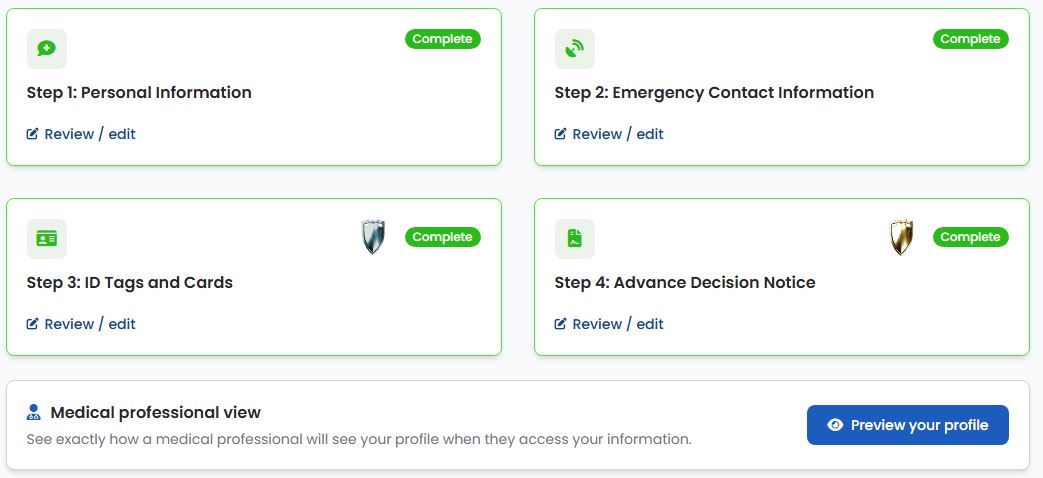
You can record information such as:
In England and Wales, an Advance Decision to Refuse Treatment can be legally binding if it has been completed correctly and applies to the treatment being considered.
A Health and Welfare Lasting Power of Attorney allows someone you trust to make certain healthcare decisions for you if you are no longer able to make those decisions yourself. It must be registered with the Office of the Public Guardian before it can be used.
The legal position is different in Scotland and Northern Ireland, which we explain further below.
Some people choose to refuse blood or certain blood products for personal, religious or other reasons.
If you have made that decision, there may be situations where you are unable to explain it yourself. MMC gives you several ways to make your wishes easier to see:
An Advance Decision can record treatments you wish to refuse. It cannot require a hospital to provide a particular alternative treatment.
If you do not wish to receive donor blood, you may want to understand what other options could be available before surgery.
There is no single type of “bloodless surgery”. What may be suitable will depend on the operation and your medical circumstances. Options can include treating anaemia beforehand, using medicines to reduce bleeding, or techniques such as cell salvage.
MMC provides a Pre-op Consultation Pack to help you prepare for discussions with your consultant and hospital team.
The pack includes information for you and your clinical team, help with preparing for the consultation, and information on alternatives to donor blood and ways of reducing the need for a transfusion.
The MMC Blood Donor Directory allows you to identify people who have chosen to be listed as blood donors and keep their details available in case the subject ever needs to be raised with your clinical team.
MMC does not test donors, medically approve them or confirm compatibility.
A donation from a named person for a named patient is known as a directed donation. UK Blood Services do not routinely support this, although it may be considered in exceptional circumstances, such as where suitably matched blood is particularly difficult to find.
Anyone being considered as a donor would still need to meet the normal eligibility, testing and compatibility requirements.
We explain this in more detail in the separate MMC Blood Donor Directory FAQs.
You can use MMC in Scotland, but some of the legal documents work differently.
Scotland uses a Welfare Power of Attorney for decisions about health and personal welfare. A welfare attorney can make relevant decisions if you are no longer able to make them yourself.
Scotland also uses advance directives to record treatments you do not want. These are not legal documents in the same way as an Advance Decision in England and Wales, but healthcare professionals can take them into account when making treatment decisions.
The arrangements in Northern Ireland are also different.
An Enduring Power of Attorney in Northern Ireland covers financial matters. It does not provide the same Health and Welfare powers as an LPA in England and Wales.
However, you can make an Advance Decision to Refuse Treatment. These are recognised under common law, provided they are valid and apply to the treatment being considered.
A next of kin does not automatically have legal authority to make healthcare decisions on your behalf.
My Medical Choice does not make medical decisions for you.
It gives you a way to record your wishes, keep important information together and make that information available if you are unable to speak for yourself.
It can also help you prepare for planned treatment by giving you information and documents to take into discussions with your clinical team.
Medical-alert systems have been used for many years to help emergency and hospital staff identify important information about a patient who may be unable to communicate.
They can alert medical staff to things such as a serious medical condition, allergies, medication, implants or a decision to refuse a particular treatment.
A medical alert can be as simple as a wristband showing a word such as “DIABETIC”, or it can provide more detailed information through a medical-alert tag or ID card.
My Medical Choice uses medical-alert tags and ID cards that carry the login details needed to access your emergency medical profile.
If you are unable to communicate, a responder who finds your tag or card can use those details to view the information you have chosen to make available.
Your medical ID card gives responders a simple way to access your emergency profile when you cannot explain your medical needs yourself.
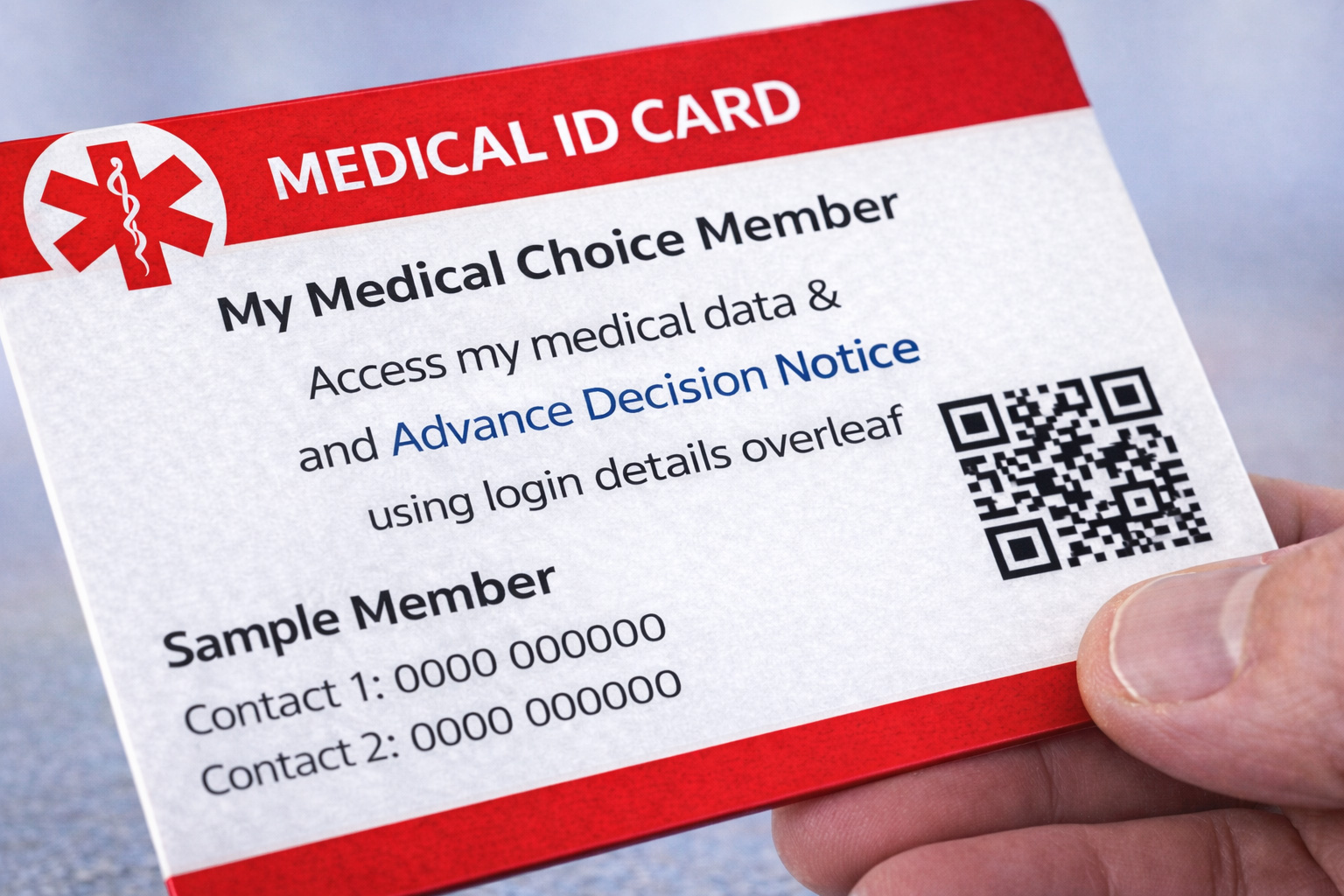
The information in your emergency profile is read-only. It can be viewed by the person treating you, but they cannot alter the information stored in your account.
Your profile can include:
Your MMC medical-alert system can also include:
These items help make important information easier to find if you are unconscious or unable to speak for yourself. There is no guarantee that every responder will access an MMC profile, but carrying your medical-alert information gives them a clear way to do so.
Yes. Your Advance Decision can be used to record specific treatments you wish to refuse, provided the document has been completed correctly and applies to the situation you are in.
For example, some people choose to refuse blood or certain blood products. MMC members can also use an optional No Blood! warning on their medical-alert items and mobile-phone screensaver.
An Advance Decision can record treatments you wish to refuse. It cannot require a hospital to provide a particular alternative treatment.
You can nominate up to two emergency contacts (ICEs) within your MMC account.
When your emergency profile is accessed through the MMC system, an automated SMS can be sent to your nominated contacts so they know that your profile has been accessed and can respond if needed.
For the best chance of your information being found when it is needed, keep your medical profile up to date and carry your MMC medical-alert information with you.
You may wish to:
The aim is straightforward: to make important medical information easier to find if you are unable to provide it yourself.
If you act responsibly with your medical-alert tag and/or ID card, then yes, your data should be quite safe.
Of course, in an emergency, emergency services access your personal health profile and ADN using the login details on your tag or card – although access is read-only. They can check the relevant medical details needed for your care, but cannot change the information they see.
Your data can only be accessed upon successful completion of a 2-step login process. This includes a unique 9-digit computer-generated passcode. The process ensures that people who know you well cannot access your data just by knowing personal details about you.
It is important that you take sensible precautions to keep your login details safe.
In the UK, blood donated by a named person specifically for a named patient is known as a directed donation.
Directed donation is not routinely supported by UK Blood Services. It can, however, be considered in exceptional circumstances where suitable blood cannot be obtained from local, national or international donor supplies for a patient with a rare red-cell or platelet type.
For example, a patient may have a particularly rare blood type or antibodies that make finding suitably matched blood unusually difficult.
Having a named donor available does not mean that their blood will automatically be accepted. The treating clinical and transfusion teams would need to decide whether directed donation was appropriate, and that donor would still have to meet the necessary eligibility, testing and compatibility requirements.
Current UK Blood Services guidance does not support directed donation solely because a patient has a personal preference concerning the COVID-19 vaccination status of the donor.
Further information: JPAC – Position statement on COVID-19 vaccines and blood transfusion, including directed donation
If you are due to have an operation and have concerns about a possible blood transfusion, we recommend discussing them with your consultant or hospital team as early as possible.
If there is a clinical reason why compatible blood may be difficult to find – for example because you have a rare blood type or particular antibodies – the hospital transfusion team can investigate this and, where necessary, seek specialist help from NHS Blood and Transplant.
NHS Blood and Transplant maintains specialist national and international resources for locating rare blood. Its International Rare Donor Panel contains details of rare donors and frozen blood units from participating countries and is available to authorised medical professionals.
If you have identified people through the MMC Blood Donor Directory, you can keep their details available and discuss this with your clinical team. There is no guarantee that a named donor will be required or accepted, but having the information ready means you are not starting from scratch if the subject needs to be raised.
MMC also provides a Pre-op Consultation Pack to help members prepare for planned surgery and consultant appointments. It is available from the member Dashboard and can be printed and taken to the consultation, together with a copy of the member’s Advance Decision where relevant.
The pack and supporting resources include:
These resources are designed to help members prepare their questions, make their treatment requirements clear and have useful information ready before they go into hospital.
Further information: NHS Blood and Transplant – International Rare Donor Panel
Yes. The MMC Blood Donor Directory and the wider My Medical Choice system can also be used by members receiving planned treatment in a private hospital.
In an accident or emergency, care will usually be through an NHS A&E department. For planned private treatment, members can make the hospital aware of their treatment requirements in advance and make their My Medical Choice health profile available if needed.
The Pre-op Consultation Pack can also be used for a private consultation. The NHS-specific policy document in the pack will not apply to a private hospital, so members should ask the hospital for its own relevant policies and patient information before the consultation.
Private treatment does not allow blood donation or transfusion to bypass the normal safety and regulatory requirements. If a member is considering a named donor for a directed donation, this should be raised with the private consultant and hospital well in advance.
Private healthcare providers are also subject to the Equality Act 2010. Members should discuss any specific requirements with the hospital and ask for its relevant policies so that concerns can be addressed before treatment.
Further information: MHRA / GOV.UK – Blood authorisations and safety reporting
This is an important and detailed subject, so we’ve covered completing an Advance Decision Notice (ADN) in our FAQs, in the User Guide provided to members, and the ADN form itself contains information boxes with each directive.
The Lasting Power of Attorney (LPA) document comes with its own guide on how to complete it. With an LPA, you will be giving a great deal of power to your Attorney in the event of a serious accident or illness where you are incapacitated – so choose your Attorney(s) wisely and, before you appoint them, talk them through your wishes regarding the healthcare treatments and procedures you prefer to reject. We provide a help sheet called ‘About My Healthcare Decisions’ to help our members deal with this difficult step.
You will also need a witness to state that you are of sound mind, and separate witnesses to sign off on certain segments of the LPA. This is explained in the user guide step-by-step. Although a lengthy and comprehensive document, the LPA does NOT require legal expertise to complete and does not require the use of a solicitor. You simply fill in your personal details and arrange Witnesses to verify the details as being true.
The ADN is a much simpler document to complete, and can be signed and witnessed digitally and then printed off to use for immediate protection.
At My Medical Choice, we stand by your side as you navigate life’s most important healthcare decisions. We respect your choices, empower your voice, and provide the tools you need to take control.