
The founder members of My Medical Choice met in 2020.
My Medical Choice is a genuine grassroots organisation and was funded exclusively by a founder member. Funds raised go towards continuous improvements to the website, creating additional services, and supporting likeminded organisations.
Privacy is at the heart of the members’ association. Only founder members who know each other personally can hold administrative positions. This ensures confidentiality for all who join.
Unlike many other organisations, My Medical Choice guarantees that we do not harvest members’ data. We also have a policy of only emailing members when necessary – for example, when we need to update them on important matters, such as a major change to website functionality, or to send out our Newsletter.
My Medical Choice is an online service that helps you keep important medical information in one place and make your healthcare wishes known if you are unable to speak for yourself.
You can record things such as medical conditions, medications, allergies, implants, emergency contacts and treatment decisions. You can also use MMC tools and documents to help you prepare for emergencies and planned hospital treatment.
Why is rapid access to medical information important in an emergency?
The term “Golden Hour” is often used to describe the early period after a serious injury, when quick assessment and treatment can be especially important.
If you are unconscious or unable to communicate, having the right medical information available quickly can help the people treating you understand your circumstances sooner.
MMC is designed to make that information easier to find.
How does My Medical Choice work in practice?
Your MMC medical-alert tag or ID card carries the login details needed to access your emergency medical profile.
If a responder finds these details, they can use them to view your profile. Access is read-only, so responders can view the information but not change it.
When your profile is accessed, MMC can also send an SMS alert to your nominated emergency contacts.
You can also use:
- MMC medical-alert jewellery or ID cards;
- a mobile-phone screensaver;
- a printed copy of your Advance Decision, if you choose to carry one.
There is no guarantee that every responder will access an MMC profile, but the system gives them a way to find important information if you cannot explain it yourself.
Your MMC account keeps your key medical information, emergency contacts, ID details and Advance Decision together in one place.
What information can I store?
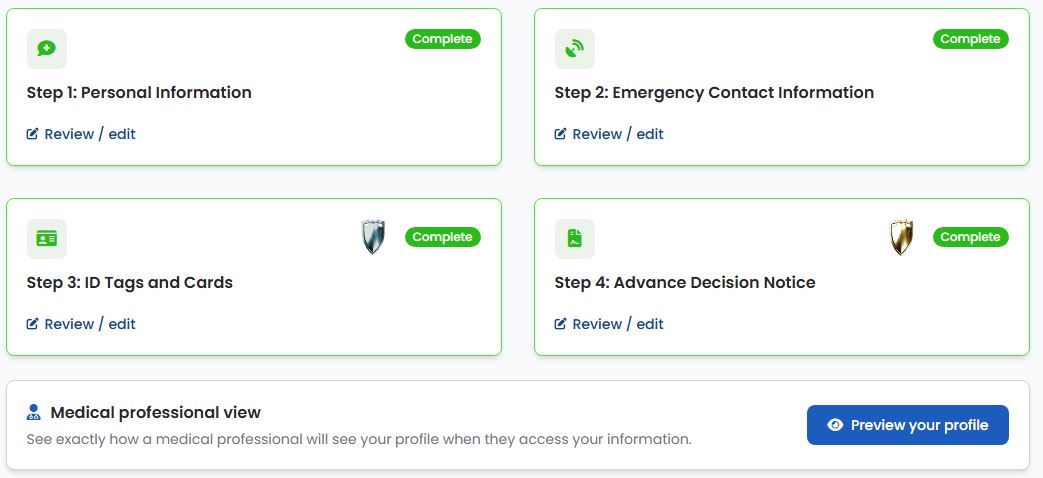
You can record information such as:
- medications you are taking;
- medical conditions;
- allergies and intolerances;
- previous operations or procedures;
- implants or medical devices;
- treatment refusals recorded in an Advance Decision;
- details of people added to My Approved Blood Donors;
- emergency contacts;
- details of an appointed attorney, where relevant.
Advance Decisions and Powers of Attorney
In England and Wales, an Advance Decision to Refuse Treatment can be legally binding if it has been completed correctly and applies to the treatment being considered.
A Health and Welfare Lasting Power of Attorney allows someone you trust to make certain healthcare decisions for you if you are no longer able to make those decisions yourself. It must be registered with the Office of the Public Guardian before it can be used.
The legal position is different in Scotland and Northern Ireland, which we explain further below.
What is the No Blood! warning system?
Some people choose to refuse blood or certain blood products for personal, religious or other reasons.
If you have made that decision, there may be situations where you are unable to explain it yourself. MMC gives you several ways to make your wishes easier to see:
- a No Blood! mobile-phone screensaver;
- optional No Blood! medical-alert tags and ID cards;
- an Advance Decision recording refusal of specified blood or blood products;
- pre-operative information to help you discuss alternatives with your clinical team.
An Advance Decision can record treatments you wish to refuse. It cannot require a hospital to provide a particular alternative treatment.
Planned surgery and alternatives to donor blood
If you do not wish to receive donor blood, you may want to understand what other options could be available before surgery.
There is no single type of “bloodless surgery”. What may be suitable will depend on the operation and your medical circumstances. Options can include treating anaemia beforehand, using medicines to reduce bleeding, or techniques such as cell salvage.
MMC provides a Pre-op Consultation Pack to help you prepare for discussions with your consultant and hospital team.
The pack includes information for you and your clinical team, help with preparing for the consultation, and information on alternatives to donor blood and ways of reducing the need for a transfusion.
MMC Blood Donor Directory
The MMC Blood Donor Directory allows you to identify people who have chosen to be listed as blood donors and keep their details available in case the subject ever needs to be raised with your clinical team.
MMC does not test donors, medically approve them or confirm compatibility.
A donation from a named person for a named patient is known as a directed donation. UK Blood Services do not routinely support this, although it may be considered in exceptional circumstances, such as where suitably matched blood is particularly difficult to find.
Anyone being considered as a donor would still need to meet the normal eligibility, testing and compatibility requirements.
We explain this in more detail in the separate MMC Blood Donor Directory FAQs.
Scotland
You can use MMC in Scotland, but some of the legal documents work differently.
Scotland uses a Welfare Power of Attorney for decisions about health and personal welfare. A welfare attorney can make relevant decisions if you are no longer able to make them yourself.
Scotland also uses advance directives to record treatments you do not want. These are not legal documents in the same way as an Advance Decision in England and Wales, but healthcare professionals can take them into account when making treatment decisions.
Northern Ireland
The arrangements in Northern Ireland are also different.
An Enduring Power of Attorney in Northern Ireland covers financial matters. It does not provide the same Health and Welfare powers as an LPA in England and Wales.
However, you can make an Advance Decision to Refuse Treatment. These are recognised under common law, provided they are valid and apply to the treatment being considered.
A next of kin does not automatically have legal authority to make healthcare decisions on your behalf.
What My Medical Choice is there to do
My Medical Choice does not make medical decisions for you.
It gives you a way to record your wishes, keep important information together and make that information available if you are unable to speak for yourself.
It can also help you prepare for planned treatment by giving you information and documents to take into discussions with your clinical team.
There are a number of well-established alternatives to standard NHS-donated blood transfusions available – including the possibility of opting for certain types of surgical procedures that avoid blood loss almost completely.
My Medical Choice provides members with fully referenced educational material and official NHS policy documents to help them understand their right to bodily autonomy. We also provide a reference library of studies and papers on blood alternatives, own-blood transfusions, and bloodless surgeries to present to consultants if needed.
To make the consultation appointment process as stress-free as possible, My Medical Choice members can use our Consultation Appointment Pack to learn about:
- the range of healthcare options available to them,
- how to ask the right questions of their consultant in a way that vastly increases their chance of getting the type of surgery and medical treatment that is best for them,
- how to follow up the appointment if a member and their consultant cannot reach an agreement.
The Consultation Appointment Pack also includes a PDF print-off guide to hand to the consultant or medical team during the appointment. This document gently explains our members’ stance on refusing NHS-donor blood transfusion and reminds them of patients’ rights. It also lists all the alternatives to blood transfusion that should be available to our members and informs them that, should the relevant equipment or staff expertise not be available at that hospital, then the member must be transferred to a hospital with the necessary medical equipment and experienced surgical team within the trust.
The following list gives an idea of some of the types of treatments and procedures that can be used to negate the need for a blood transfusion.
HAEMODIALYSIS
Diverts the blood into an external machine where it filters and cleans the patient’s own blood for return to the body. This procedure is suitable for members provided non-blood prime is used.
HAEMODILUTION
Diverts the blood into an external machine where it filters and cleans the patient’s own blood for return to the body. This procedure is suitable for members provided non-blood prime is used.
CELL SALVAGE MACHINES
Cell salvage technology systems, such as Hemosep, are a relatively new ultrafiltration and haemoconcentration system for concentrating residual bypass blood during or after surgery. The image below gives an idea of how these types of machine work in practice.
The image shows a continuous circuit in cell salvage, which can be requested by members.
HEART BYPASS
Diverts blood away from the heart. This procedure is suitable for members provided that non-blood prime is used.
PREOPERATIVE AUTOLOGOUS COLLECTION
Our members can also consider preoperative collection and subsequent reinfusion – although we recommend members sign and date the blood bag label to ensure chain of authenticity.
EXPANDERS
Non-blood volume expanders to ‘pad out’ blood volume can be used, such as: saline, dextran, gelatin, Ringer’s Solution, haemaccel, and hetastarch.
TRANEXAMIC ACID
This substance is used to control bleeding and helps blood to clot.
BLOODLESS SURGERY
In addition to the various choices available for alternatives to blood transfusion, members are also provided with information regarding the use of low blood-loss haemostatic surgical devices for so-called ‘bloodless surgery’.
Medical-alert systems have been used for many years to help emergency and hospital staff identify important information about a patient who may be unable to communicate.
They can alert medical staff to things such as a serious medical condition, allergies, medication, implants or a decision to refuse a particular treatment.
A medical alert can be as simple as a wristband showing a word such as “DIABETIC”, or it can provide more detailed information through a medical-alert tag or ID card.
How does the My Medical Choice alert system work?
My Medical Choice uses medical-alert tags and ID cards that carry the login details needed to access your emergency medical profile.
If you are unable to communicate, a responder who finds your tag or card can use those details to view the information you have chosen to make available.
Your medical ID card gives responders a simple way to access your emergency profile when you cannot explain your medical needs yourself.
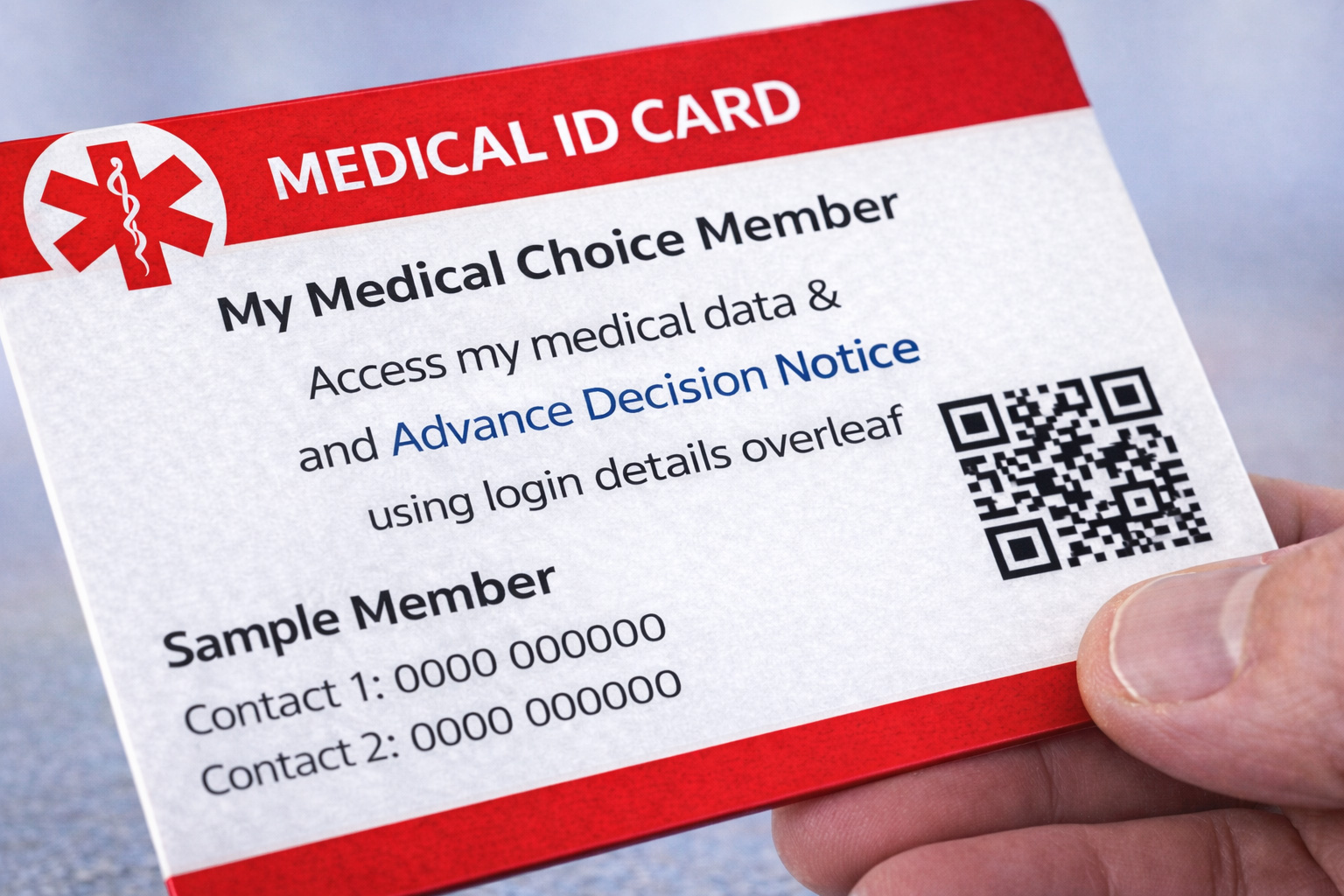
The information in your emergency profile is read-only. It can be viewed by the person treating you, but they cannot alter the information stored in your account.
Your profile can include:
- medical conditions;
- medications you are taking;
- allergies and intolerances;
- implants or medical devices;
- GP details;
- emergency contact details;
- important treatment refusals recorded in your Advance Decision;
- a “pet at home alone” alert, if needed;
- an optional “No Blood!” warning.
What else can I use?
Your MMC medical-alert system can also include:
- medical-alert jewellery or tags;
- an MMC medical ID card;
- a mobile-phone screensaver;
- a printed copy of your Advance Decision, if you choose to carry one.
These items help make important information easier to find if you are unconscious or unable to speak for yourself. There is no guarantee that every responder will access an MMC profile, but carrying your medical-alert information gives them a clear way to do so.
Can I record treatments I do not want?
Yes. Your Advance Decision can be used to record specific treatments you wish to refuse, provided the document has been completed correctly and applies to the situation you are in.
For example, some people choose to refuse blood or certain blood products. MMC members can also use an optional No Blood! warning on their medical-alert items and mobile-phone screensaver.
An Advance Decision can record treatments you wish to refuse. It cannot require a hospital to provide a particular alternative treatment.
What happens to my emergency contacts?
You can nominate up to two emergency contacts (ICEs) within your MMC account.
When your emergency profile is accessed through the MMC system, an automated SMS can be sent to your nominated contacts so they know that your profile has been accessed and can respond if needed.
How can I make the system easier to find in an emergency?
For the best chance of your information being found when it is needed, keep your medical profile up to date and carry your MMC medical-alert information with you.
You may wish to:
- wear your medical-alert jewellery or tag regularly;
- keep your medical ID card in your wallet or purse;
- use the MMC mobile-phone screensaver;
- carry a copy of your Advance Decision where appropriate;
- check that your emergency contacts and medical information remain up to date.
The aim is straightforward: to make important medical information easier to find if you are unable to provide it yourself.
In England and Wales, an Advance Decision Notice (ADN) is a legally-binding document that is probably better known as a ‘living will’. An ADN allows you to stipulate which medical treatments and procedures you wish to reject. It represents your voice in medical situations where you are unable to communicate.
In Scotland and Northern Ireland, an ADN is called an Advanced Directive and is not considered legally binding*. However, if one of your medical decisions were ever to be challenged in the courts, provided the Advance Directive was valid (that is, you had completed it properly and had your signature witnessed) and applicable to the circumstances (meaning the situation being raised in court was one covered by the directives you had written into your Advance Directive), it is likely a judge would rule in favour of respecting it.
One of the general principles of the Adults with Incapacity (Scotland) Act 2000 is that if someone lacks capacity to make a decision for themselves and needs medical treatment, the adult’s wishes should be taken into consideration when making a decision on their behalf; you should therefore be protected legally, since the Advance Directive allows you to stipulate your express wishes regarding your medical treatment in advance while you have the capacity to do so.
* In Northern Ireland, the relevant NHS protocol is: the Northern Ireland Pathway for the Management of Adult Patients Who Decline Specified Blood Components or Blood Products (CG424)
The My Medical Choice ADN is an easy-to-complete online form in which you simply tick the box next to the directives you choose to include on your completed ADN. Only the directives you tick will be included on your completed ADN. You can then upload your signature and that of your witness to the ADN digitally, or print it off and sign and witness it in wet ink. The hard copy can then be scanned and uploaded into your account page for emergency services to access if needed.
If you have a GP, we suggest sending them a copy using the cover letter template we provide in order to notify your GP that your ADN needs adding to your records.
Our ADN allows you to:
- tick the directives you wish to be added to the completed document – only the selected directives will appear on the final document;
- tick a “pet at home alone” warning if applicable;
- understand the implications of ticking each directive by way of pop-up information boxes where you see the information icon – – next to the directive – The information boxes include the legal/medical explanation for officially-named treatments and procedures you may wish to refuse;
- use the ADN in hard copy format, as it folds down to purse/wallet size in case a member wishes to carry it on them – perhaps while waiting for their medical alert tags or cards to arrive;
- use electronic signatures for both the member and their witnesses – although the document can also be printed off and signed in wet ink and uploaded;
- save and upload the completed ADN at the click of a button; and
- easily update the ADN digitally.
For maximum legal protection, we suggest you give a copy of your ADN to your ICE or Attorney, as well as your GP.
IMPORTANT! We suggest you review the directives in your ADN on an annual basis to ensure there’s nothing new you’d like to add or remove. You should then sign the new version (even if you make no changes to it), and send the updated copy to your GP. The online system makes this very quick and easy to do.
The annual revision of your directives and updated witnessed signature makes it difficult for anyone to argue that you have lost mental competence since your legal documents were last updated.
A Lasting Power of Attorney (LPA), (Welfare Power of Attorney in Scotland) (WPA) is a more detailed and complex legal document than the ADN and serves a different purpose.
An LPA allows you to name one or more Attorneys* to oversee your care in the event you are not competent to make healthcare decisions, such as when unconscious after a serious accident. Once you’ve nominated an Attorney, they must uphold your wishes for medical treatment (as stipulated in your ADN).
It should be noted that the LPA has no further reach than as described and you would need to set up other types of Power of Attorney documents if you require additional protection – to deal with your property or finances, for example.
In the LPA document you are referred to as the Donor (not to be confused with blood donor), because you are ‘donating’ the responsibility for your care to an Attorney in the event you lack capacity due to an emergency. Attorneys must be over 18.
The LPA must also be witnessed (called the Certificate Provider’s Statement in the document) to state you are of sound mind, which makes it very difficult for family or medical personnel to challenge your directives later on.
Being taken to hospital (even a ‘private’ hospital) puts you firmly in the public domain, and because you will be in the public domain – whilst also at your most vulnerable – we recommend members only use the government’s version of the LPA. Members should also register their completed LPA with the appropriate court of protection for their country.
In an emergency, emergency services and A&E staff will be aware that you have an LPA document from the data you stored in our database. If they wish to verify the validity of the LPA with the court, they can do so quickly and easily. From that point on, they must take instruction from the medical directives expressed in your ADN and also your Attorney(s).
*An ‘Attorney’ in this sense, is a person who is legally appointed to make medical decisions for someone else. They require no legal or medical experience but it’s important to choose someone like-minded, trustworthy, and reliable. Your Attorney should be listed as your ICE in the medical-alert system, and you can nominate up to two Attorneys to receive the automated SMS alert in an emergency.
If you’ve had a major operation in recent years, or given birth, your GP should have this information on your medical records, so check with them first. If you have donated blood, you are normally told your blood type about a week after donating.
What if your GP doesn’t have your blood type on record?
One option is a home test kit. It’s really quick and easy to do a finger prick test in the privacy of your own home. The most popular home testing kit is the Eldon Blood Typing Kit from ZoomHealth*.
The most professional option is to use a private medical ABO blood typing test. It is more costly, but it is something that you will only ever need to do once in your life. You will need to have a blood sample taken, which is sent off to a lab for analysis.
If you choose the ABO blood type testing, we suggest the Medichecks Blood Group Test for professional accuracy and a four-working-days turnaround time. At the time of writing, the test costs around £80, and Medichecks has a range of clinics nationwide should you need to have your blood taken by a healthcare professional.**
Please note that, whichever blood type test you use, the NHS may still insist on using their own ABO blood type test for you and your donors.
* Please note that ZoomHealth doesn’t recommend their tests be used for the purpose of blood donation. If used correctly, however, the ZoomHealth test should give you your blood type for the purpose of organising compatible donors.
** If you need to have your blood taken by a medical professional, or a nurse, there will be an additional cost depending on the option you choose.
It may shock you to know that in the event you are rushed into A&E, the hospital will not necessarily have medical records for you. This is because the NHS is broken up into individual trusts – usually by county. They each have their own computer system, they don’t share the information between trusts, and they can’t access each other’s records, either.
In reality, the NHS only has medical records for you if:
- you were a patient at the hospital before, and
- you provided detailed information at that time, or
- you are admitted into a hospital within the same Trust as the hospital to which you previously provided medical information.
If you have an accident in another county, the NHS has no way of accessing your records. And if you’ve never been to hospital before, the NHS can’t access your records unless you can provide GP details. This will not work if you are in hospital when your GP surgery is closed or you are unable to communicate your GP’s details.
So, you can see why a medical-alert service is a good idea!
The best way to get the most out of our service is to think of the worst-case scenario, one in which you are seriously ill or have been involved in an accident and are unconscious or unable to communicate. Then consider what information would help those caring for you to achieve the best possible outcome for your health.
The list of details below will help emergency services and A&E staff give you the most appropriate care for your needs.
- List any medical implants, such as: pacemaker, neurostimulator, aortic valve, and so on.
- List any conditions you may have: diabetes (Type 1 or 2), autoimmune conditions, COPD, asthma, etc.
- List any previous operations, or state if you have received a donated organ.
- List any serious allergies – in particular, anything that may cause anaphylaxis: peanuts, penicillin, wasp or bee stings, latex, dairy, and so on.
- List any medication or procedures you need to avoid: aspirin, ibuprofen, blood transfusions, MRI scans, invasive testing, etc.
- List medication you take regularly, including the dose and frequency (1 a day, 2 a day, etc.)
- List medication you take as and when needed: painkillers, diuretics, sleeping tablets, etc.
- List medication or devices you carry on you: steroid inhaler, EpiPen, anti-anxiety medication, etc.
And remember… if you forget to add a medication or condition to your personal medical profile, or you develop an illness and start taking medication after signing up to the My Medical Choice service, you can update your profile and legal documents as often as you need to.
If you act responsibly with your medical-alert tag and/or ID card, then yes, your data should be quite safe.
Of course, in an emergency, emergency services access your personal health profile and ADN using the login details on your tag or card – although access is read-only. They can check the relevant medical details needed for your care, but cannot change the information they see.
Your data can only be accessed upon successful completion of a 2-step login process. This includes a unique 9-digit computer-generated passcode. The process ensures that people who know you well cannot access your data just by knowing personal details about you.
Keeping your login details safe
It is important that you take sensible precautions to keep your login details safe.
- Avoid taking off your medical-alert tag or jewellery or leaving it lying around where others can access the login details. You should wear your medical-alert jewellery at all times. It is there for your protection in an emergency. If you lose your medical-alert jewellery, change the passcode immediately to keep your data safe.
- Keep your medical ID cards safe in your purse/wallet at all times, or secure in the glove compartment of your car.
- Only share your login data with people you trust – such as your emergency contacts (ICEs) or Attorney.
We maintain transparency with our members, ensuring they are well-informed about the security of their data.
At My Medical Choice, the scope of personal medical information stored is significantly less comprehensive than the detailed records maintained by GPs and the NHS. Please bear in mind that extensive data is often shared with government entities and sold to private agencies. By contrast, our platform gives you control over how much data you add to your medical profile. The essential principle is to include only vital medical information that could be crucial in emergency situations to enhance the effectiveness of your care. For example, you do not need to include sensitive mental health details.
My Medical Choice is about being prepared and having important information ready before you need it. That includes situations involving blood transfusions.
For most people, the usual UK blood services can provide suitable blood. But for some, it can be more complicated. This may be because they have a rare blood type, particular antibodies, or other factors that make matching blood more difficult.
For example, someone may have antibodies that mean finding suitable blood is not simply a case of matching the usual ABO blood group. In these situations, more specialist testing may be needed.
This is one of the reasons we created the MMC Blood Donor Directory. It gives members another practical way to prepare and allows them to identify people who have chosen to be listed in the directory.
The aim is to have useful information available before a difficult situation arises, rather than trying to work everything out when someone is already in hospital and under pressure.
Having information ready can help reduce delay, uncertainty and stress for both the member and their loved ones. It also gives them something they can raise with their clinical team if the situation calls for it.
The directory does not replace NHS Blood and Transplant, hospital transfusion teams, laboratory testing or the normal clinical process. Someone listed in the directory is not automatically eligible or compatible, and any donation would still need to go through the proper professional checks.
For us, this is about making sure members are as prepared as possible. By thinking ahead and putting the right information in place before it is needed, My Medical Choice helps give members and their families greater confidence, clarity and peace of mind if a difficult situation arises.
What is the MMC Blood Donor Directory?
The MMC Blood Donor Directory is a preparedness resource that allows members to identify and make contact with people who have chosen to put themselves forward as blood donors.
Some members may have personal preferences concerning a donor’s medical, treatment or vaccination history. The directory allows those listed to provide relevant information about themselves voluntarily. This information is self-reported.
Being listed does not mean that a person has been medically approved to donate blood to a particular member, or that their blood has been confirmed as compatible.
My Medical Choice does not collect, test, process or supply blood, and does not arrange blood transfusions. Any blood intended for transfusion would need to go through the appropriate clinical, laboratory and regulated blood-service procedures.
My Medical Choice does not determine the safety or quality of a person’s blood based on their vaccination status.
Can anyone donate blood?
No. Being listed in the directory does not automatically mean that someone is medically eligible to donate blood.
Eligibility can be affected by medical conditions, certain medications, previous blood transfusions and other health or safety factors. For example, some cancers can prevent a person from donating, and NHS guidance states that people who have received a blood transfusion from 1980 onwards cannot donate.
Having the same familiar blood group – for example A+, O- or B+ – also does not necessarily mean that two people are fully compatible. If someone listed in the directory were being considered as a donor, their eligibility and compatibility would need to be established through the appropriate professional blood-service and laboratory procedures.
The MMC donor form allows people listed in the directory to provide information about medical conditions and medications. This gives members more information when deciding who they may wish to contact, but the information is self-reported and does not replace professional donor screening.
Further information: NHS Blood and Transplant – Who can give blood?
In the UK, blood donated by a named person specifically for a named patient is known as a directed donation.
Directed donation is not routinely supported by UK Blood Services. It can, however, be considered in exceptional circumstances where suitable blood cannot be obtained from local, national or international donor supplies for a patient with a rare red-cell or platelet type.
For example, a patient may have a particularly rare blood type or antibodies that make finding suitably matched blood unusually difficult.
Having a named donor available does not mean that their blood will automatically be accepted. The treating clinical and transfusion teams would need to decide whether directed donation was appropriate, and that donor would still have to meet the necessary eligibility, testing and compatibility requirements.
Current UK Blood Services guidance does not support directed donation solely because a patient has a personal preference concerning the COVID-19 vaccination status of the donor.
Further information: JPAC – Position statement on COVID-19 vaccines and blood transfusion, including directed donation
What if I have an operation scheduled where I may require blood?
If you are due to have an operation and have concerns about a possible blood transfusion, we recommend discussing them with your consultant or hospital team as early as possible.
If there is a clinical reason why compatible blood may be difficult to find – for example because you have a rare blood type or particular antibodies – the hospital transfusion team can investigate this and, where necessary, seek specialist help from NHS Blood and Transplant.
NHS Blood and Transplant maintains specialist national and international resources for locating rare blood. Its International Rare Donor Panel contains details of rare donors and frozen blood units from participating countries and is available to authorised medical professionals.
If you have identified people through the MMC Blood Donor Directory, you can keep their details available and discuss this with your clinical team. There is no guarantee that a named donor will be required or accepted, but having the information ready means you are not starting from scratch if the subject needs to be raised.
MMC also provides a Pre-op Consultation Pack to help members prepare for planned surgery and consultant appointments. It is available from the member Dashboard and can be printed and taken to the consultation, together with a copy of the member’s Advance Decision where relevant.
The pack and supporting resources include:
- Pre-op Guide for Members
- Pre-op Guide for Consultants
- the relevant NHS policy document for patients who refuse blood
- a follow-up template for use if important points are not resolved during the consultation
- information on advocacy and representation support
- information on established alternatives to donor blood
- the “Optimising Blood for Surgery” help sheet
These resources are designed to help members prepare their questions, make their treatment requirements clear and have useful information ready before they go into hospital.
Further information: NHS Blood and Transplant – International Rare Donor Panel
Does this service apply in private hospitals?
Yes. The MMC Blood Donor Directory and the wider My Medical Choice system can also be used by members receiving planned treatment in a private hospital.
In an accident or emergency, care will usually be through an NHS A&E department. For planned private treatment, members can make the hospital aware of their treatment requirements in advance and make their My Medical Choice health profile available if needed.
The Pre-op Consultation Pack can also be used for a private consultation. The NHS-specific policy document in the pack will not apply to a private hospital, so members should ask the hospital for its own relevant policies and patient information before the consultation.
Private treatment does not allow blood donation or transfusion to bypass the normal safety and regulatory requirements. If a member is considering a named donor for a directed donation, this should be raised with the private consultant and hospital well in advance.
Private healthcare providers are also subject to the Equality Act 2010. Members should discuss any specific requirements with the hospital and ask for its relevant policies so that concerns can be addressed before treatment.
Further information: MHRA / GOV.UK – Blood authorisations and safety reporting
This is an important and detailed subject, so we’ve covered completing an Advance Decision Notice (ADN) in our FAQs, in the User Guide provided to members, and the ADN form itself contains information boxes with each directive.
The Lasting Power of Attorney (LPA) document comes with its own guide on how to complete it. With an LPA, you will be giving a great deal of power to your Attorney in the event of a serious accident or illness where you are incapacitated – so choose your Attorney(s) wisely and, before you appoint them, talk them through your wishes regarding the healthcare treatments and procedures you prefer to reject. We provide a help sheet called ‘About My Healthcare Decisions’ to help our members deal with this difficult step.
You will also need a witness to state that you are of sound mind, and separate witnesses to sign off on certain segments of the LPA. This is explained in the user guide step-by-step. Although a lengthy and comprehensive document, the LPA does NOT require legal expertise to complete and does not require the use of a solicitor. You simply fill in your personal details and arrange Witnesses to verify the details as being true.
The ADN is a much simpler document to complete, and can be signed and witnessed digitally and then printed off to use for immediate protection.
Yes, you can. This service will be available soon.
The law throughout the UK does not allow children to use Advance Decision Notices and appoint Attorneys, and they cannot join My Medical Choice as members in their own right.
However, we are providing the option to have children’s crucial medical information added to the member parent’s account, to avoid medical error in the event of an accident. Children will need their own medical-alert tag, and their parent(s) listed as an emergency contact to ensure the parent is automatically notified if their child is admitted to hospital.
Also consider that although minors under the age of 18 cannot join My Medical Choice in their own right, they benefit from having parents that are members. Our members are well informed on patient rights regarding healthcare decisions, as well as on the laws applicable to bodily autonomy and informed consent.
The annual subscription is £49 per year, or £5 per month. Access to all the services detailed above is included and you can access and make changes to your profile and documents as often as required.
You can sign up here to begin using the service.
Medical-alert jewellery tags and ID cards
Please note that the subscription does not include the cost of medical-alert jewellery and ID cards. The mobile-phone screensaver is available for free download to subscribers.
Although we offer links to a selection of retailers that offer a variety of suitable jewellery tags once you become a member, you are free to choose whatever medical-alert jewellery you like from any supplier you prefer. Just ensure the tag has a large enough surface to hold your login credentials – although the seller should let you know if the jewellery you have chosen is suitable before they engrave it.
The cost of medical alert jewellery varies tremendously. It really depends on your budget and whether you favour functionality or style. For example, you can choose simple coloured silicon bands that cost a couple of pounds, or choose a bespoke designer option in precious metals for a much higher cost. It is entirely up to you. Both options will do the same job.
For those on a tight budget, medical ID cards may be the better choice.
There are other accessories you can buy, such as key rings and plastic holders for your ADN, but consider that emergency services will check pulse points for necklaces and bracelets, and search purses and wallets for medical ID cards.
* My Medical Choice does not receive commission from any of the sellers listed. The sellers are suggested solely for your convenience.
Below you will find links to further information regarding the topics covered on this website.
Legal Documents
Advance Decision Notice (England and Wales)
Advance Directive (Scotland and Northern Ireland)
Lasting Power of Attorney (England and Wales)
Welfare Power of Attorney (Scotland)
Enduring Power of Attorney (Northern Ireland)
Refusing Blood Transfusions and Blood Components
St George’s University Hospitals Trust produced the document in this link – however, all NHS hospital trusts have very similar policies in place for refusing blood transfusions and blood products.
Children and Young Adults
Children, and Young Adults (over 16-years but under 18-years) and Consent to Treatment
Office of the Public Guardian
Telephone: 0300 456 0300
Textphone: 0115 934 2778
Monday, Tuesday, Thursday and Friday, 9.30am to 5pm
Wednesday, 10am to 5pm
Donating Blood
Blood given via the NHS is routinely tested for: infection with hepatitis B, hepatitis C, hepatitis E, HIV, HTLV, and syphilis. Blood may also be tested for malaria or West Nile virus.
Guidelines on donating blood in Scotland
Scotland already has a system in place in which blood donors register to be on standby to give blood within 24 hours:
24-hour standby blood donation, Scotland
Who Can Give Blood?
NHS blood and transplant website
NHS Wales regulations on who can donate