

Creating an Advance Decision to Refuse Treatment (ADRT) in England and Wales
ADRT stands for Advance Decision to Refuse Treatment. It is a way to record specific medical treatments you would refuse in the future if you are unable to make or communicate that decision yourself.
Learn how to make your treatment decisions clear, so they can help guide your care if you cannot communicate.
Clinically Reviewed | 8 June 2026
This article has been reviewed for clinical accuracy, patient safety, and appropriate presentation of medical information by Aliese Oxenham, BSc in Nursing and Social Work, RN.
A full reviewer disclosure is provided at the end of this article.
Verify Aliese Oxenham’s NMC registration status via the NMC register
An Advance Decision to Refuse Treatment is recognised under the Mental Capacity Act 2005, but it can only guide your care if it is valid, applicable, and the right people know it exists. This guide explains how to create an Advance Decision, what makes it legally recognised, and how to make sure your wishes are easier to find in an emergency.
Note: If you are searching for how to create an advance decision in the UK, it is important to know that the legal framework explained in this guide applies specifically to England and Wales.
Key Takeaways: Advance Decisions in England and Wales
- An advance decision allows you to refuse specific medical treatments in the future.
- You must have capacity at the time you make it.
- Life‑sustaining treatment refusals require specific wording, signatures and a witness.
- There is no central register, making sharing and recording essential.
- You have the right to refuse medical treatment under law.
- A digital medical profile, emergency card or QR access system can help make key instructions easier to locate.
- An Advance Decision helps clearly record your medical wishes so they can guide your care if you are unable to communicate.
What Does “Valid and Applicable” Mean?
For an Advance Decision to Refuse Treatment (ADRT) to be followed by medical staff, it must be both valid and applicable at the time treatment is being considered. “Valid” means it has not been withdrawn, replaced, or undermined by later actions. For example, an ADRT may be treated as invalid if you later do something clearly inconsistent with that decision, or if you later create a Health and Welfare Lasting Power of Attorney, LPA, giving someone else authority to make the same treatment decision.
“Applicable” means the ADRT must clearly relate to the treatment and circumstances now being faced. Under Section 25 of the Mental Capacity Act 2005, an ADRT may not be applicable if the treatment being considered is not the treatment specified in the document, if the circumstances described in the document are not present, or if there are reasonable grounds to believe that new circumstances have arisen which you did not anticipate and which may have affected your decision.
This is why your ADRT should be specific, reviewed regularly, and updated whenever your beliefs, medical condition, treatment preferences, or legal arrangements change.
Visual summary: How to create an Advance Decision in England and Wales
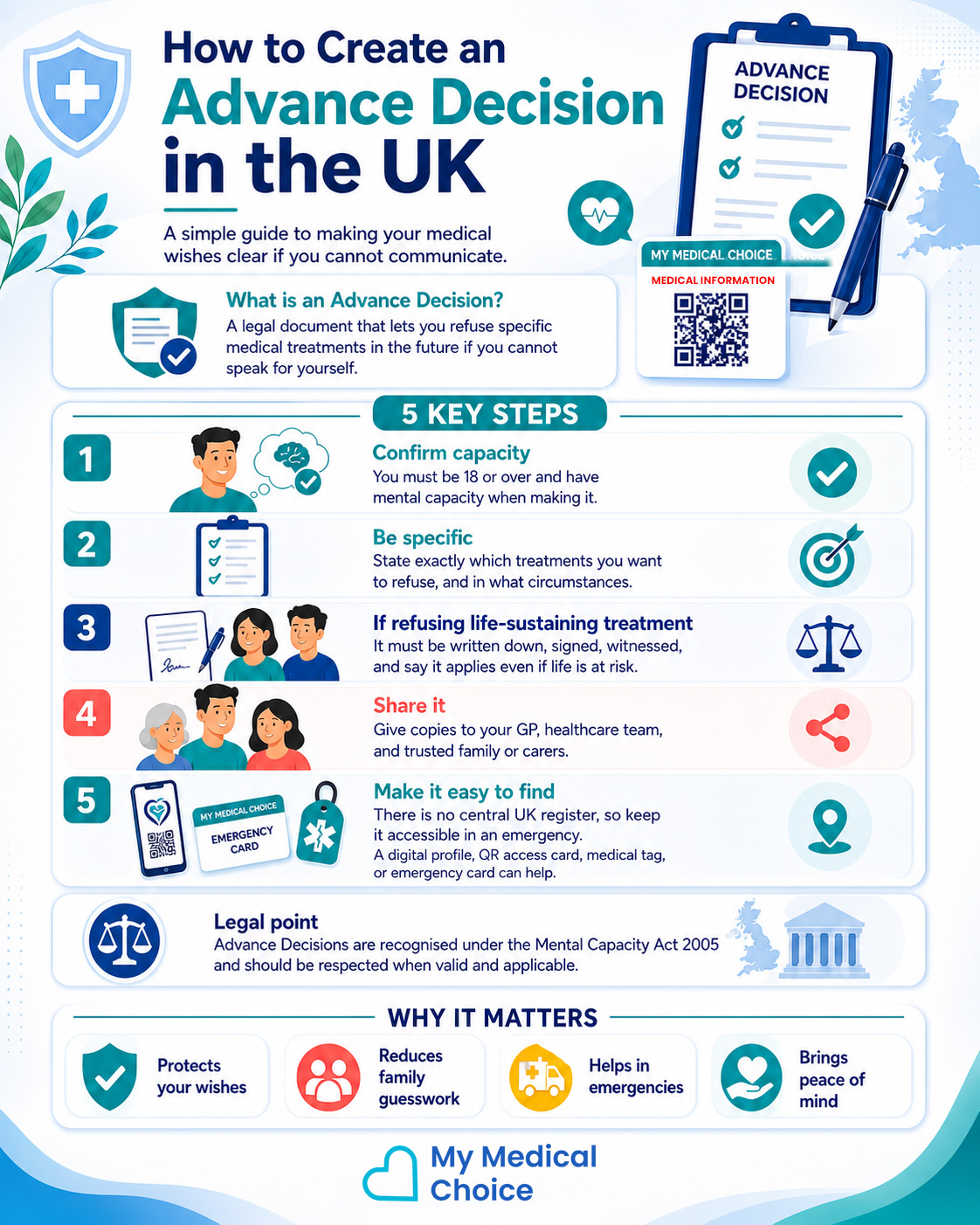
This infographic summarises the key points from our full guide to creating an Advance Decision in England and Wales. It covers why your wishes must be clear, valid, shared with the right people, and easy to find in an emergency.
Before going through the steps, it is worth noting one practical issue many people overlook: your Advance Decision must be easy to find when needed.
Why Your Advance Decision Must Be Easy to Find
Creating an Advance Decision is an important step, but it is only useful if the right people can find it when it is needed.
In the UK, there is no single nationwide register where every Advance Decision is stored. This means healthcare professionals may not automatically know that you have one in place, especially in an emergency.
That is why it is important to make sure your GP has a copy. You should also tell close family members, trusted friends, carers, or anyone likely to be contacted if you become seriously unwell. They should know that your Advance Decision exists and where it can be found.
Emergency situations can move very quickly. If you cannot speak for yourself, decisions may need to be made before your loved ones arrive or before your full medical history is available. The easier your instructions are to find, the more likely they are to be considered at the right time.
A digital medical profile, emergency card, medical tag, or QR access system can help make key information easier to locate. This does not replace the need for a properly written Advance Decision, but it can help point healthcare professionals and loved ones towards your wishes when time matters most.
My Medical Choice helps people make their emergency medical wishes easier to find if they cannot speak for themselves, by keeping key instructions, contacts and treatment preferences accessible in one secure place.
Steps to Create an Advance Decision
- Decide which medical treatments you want to refuse
- Write your Advance Decision clearly
- Ensure it meets legal requirements
- Share it with your GP and relevant people
- Keep it accessible in case of an emergency
Is an Advance Decision legally binding?
Advance Decisions are legally recognised in England and Wales under the Mental Capacity Act 2005, and when valid and applicable, must be taken into account by healthcare professionals.
Understanding Advance Decisions and Why They Matter
An advance decision (sometimes called an ADRT or advance directive) is a formal declaration that specifies the medical treatment or treatments you do not want to receive in the future if you lose the ability to make or communicate decisions.
It ensures your choices are respected and reduces the burden on families who might otherwise struggle to interpret your wishes, especially during emergencies.
How to Create an Advance Decision to Refuse Treatment
Step One: Confirm You Have Capacity
You must be aged 18 or over and have the mental capacity to understand your choices at the time you make an advance decision. You need to understand what is being refused, what it means, and the consequences of your choices. nhs.uk
Step Two: Be Specific
Your advance decision must clearly state:
- What treatment(s) you are refusing
- The exact circumstances in which the refusal applies
For example, you might refuse certain antibiotics only if you are permanently unconscious.
Being specific improves clinical understanding and helps reduce ambiguity.
Step Three: Refusing Life‑Sustaining Treatment
If you are refusing life-sustaining treatment such as ventilation or CPR, the advance decision must:
• Be in writing
• Be signed by you
• Be witnessed
• Clearly state that it applies even if your life is at risk
For an ADRT refusing life-sustaining treatment to be valid, the witness is there to confirm that they saw you sign the document, not to assess your mental capacity or approve the decision itself. As good practice, your witness should be an independent adult, not a close family member, not someone named in your will, and not anyone who could be seen as benefiting from your death. This helps reduce the risk of the document being questioned later, especially if medical staff are concerned about pressure, influence or coercion.
These additional requirements help ensure the advance decision is legally binding in those circumstances.
Step Four: Communicate Your Decision
An advance decision is only useful if others know about it. Discuss it with:
- Your GP
- Members of your healthcare team
- Close family or carers
Clear communication ensures your wishes are accessible when needed.
How to Register an Advance Directive Refusing Specific Treatments
There is no central national register for advance decisions in the UK, so taking steps to ensure your document is available is important.
Share With Your GP Practice
Once your advance decision is complete, it is strongly advised that you email or hand it to your GP practice. Ask them to add it to your NHS medical records.
This is crucial because your GP record is often accessed in urgent medical situations.
Share With Trusted People
You should also:
- Give copies to family, carers, or appointed representatives
- Keep your own copy in a safe but accessible place
Advance decisions only work if they are known and accessible when needed.
Your Right to Refuse Medical Treatment Under UK Law
Your right to refuse medical treatment in the UK is well recognised. If you are competent, you can refuse any medical treatment, even if this could lead to serious harm or death.
This right is grounded in:
- The Mental Capacity Act 2005, which provides the legal basis for advance decisions and protects your autonomy. Legislation.gov.uk
- Healthcare practitioners must respect a valid, applicable advance decision.
If You Have No Advance Decision
If you lose the ability to decide and you do not have a valid advance decision, treatment decisions will be made in your best interests under the Mental Capacity Act.
Limitations and Exceptions
There are some exceptions, particularly under the Mental Health Act 1983 for certain situations such as compulsory treatment for mental disorders. This does not negate your overall right to refuse treatment but creates some narrow legal exceptions.
Compassionate Planning and Personal Empowerment
Creating an advance decision is not about giving up care. It is about expressing your personal values and treatment preferences clearly and confidently.
Planning ahead can:
- Reduce stress and uncertainty
- Free your loved ones from difficult guesswork
- Ensure your priorities are understood and respected
These discussions can also improve relationships and clarify expectations.
Where to Get Help Creating or Sharing an Advance Decision
Many people seek support when planning advance decisions or discussing treatment refusal. Here are trusted ways to get professional input:
My Medical Choice Online System
My Medical Choice provides a dedicated online system to help you prepare and update your Advance Decision Notice (ADN). This tool allows you to:
- Complete your ADN online with structured support
- Review and revise it as your circumstances or preferences change
- Keep your choices clearly documented
A key benefit of the My Medical Choice system is its electronic nature, allowing you to revise your ADN at any time. Once completed, you should email or hand it to your GP practice so that it becomes part of your medical note.
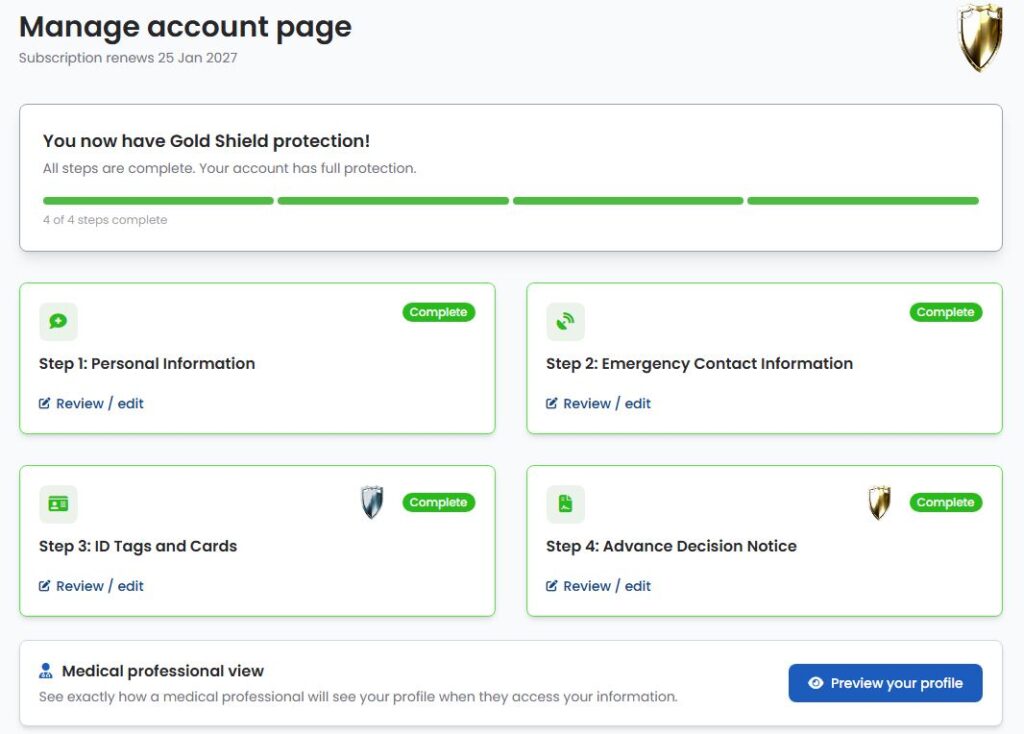
… Below is a screenshot from one of the pages in the My Medical Choice digital ADN form.
NHS Services
The NHS App lets you book appointments or contact your GP for advice on treatment decisions, though it does not create advance decisions itself.
Private Consultations
Some platforms such as private GP services allow you to book consultations to discuss your situation if you need more time or personalised advice.
Support organisations and charities often provide additional guidance and resources that accompany clinical advice.
Real World Examples
Planning With Confidence
Oliver, aged 75, used the My Medical Choice system to complete his Advance Decision Notice. After sharing it with his GP and family, his wishes were clearly documented and available during a later hospital stay…
Sharing Matters
A My Medical Choice blog post highlights what can happen when advance decisions are overlooked. This underscores why sharing documentation with your GP, family and care team is essential for effective implementation. (See supporting blog – When an Advance Decision Is Overlooked: A Wake-Up Call for Us All)
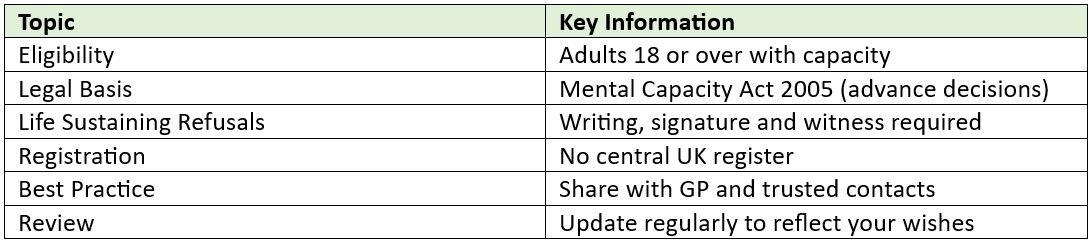
Summary Table: Advance Decisions at a Glance
Frequently Asked Questions
Planning your medical future can raise many questions, especially regarding your right to decline certain interventions. In England and Wales, the Mental Capacity Act 2005 legally protects your choices, ensuring that healthcare professionals must respect a valid advance decision. Crucially, refusing a specific treatment never means you will be left without care; your medical team will simply pivot your support towards comfort care, pain relief, and alternative treatments that honour your wishes.
What is an advance decision to refuse treatment?
An advance decision is a legal document that allows you to refuse specific medical treatments in the future if you are unable to communicate or make decisions for yourself.
Is an advance decision legally recognised by the NHS?
Yes. A valid and applicable advance decision is legally recognised in England and Wales under the Mental Capacity Act 2005 and must be respected by healthcare professionals.
Does refusing treatment mean no care at all?
No. Refusing specific medical interventions does not mean your healthcare stops. Under the Mental Capacity Act 2005, you have the legal right to decline any treatment, and medical professionals must respect your choice.
Do I need a solicitor to make an advance decision?
No. Most people do not need legal advice to create an advance decision, although some may choose to seek additional reassurance if their situation is complex.
What happens if I do not have an advance decision?
If you lose capacity and do not have an advance decision, medical decisions will be made in your best interests under the Mental Capacity Act, often involving clinicians and family members.
Can I refuse life-sustaining treatment in an advance decision?
Yes, but additional legal requirements apply. Refusals of life-sustaining treatment must be written, signed, witnessed (as per the My Medical Choice ADN form), and clearly state that the refusal applies even if life is at risk.
Can I change or cancel my advance decision later?
Yes. You can amend or withdraw your advance decision at any time while you have mental capacity.
How do doctors know about my advance decision in an emergency?
Advance decisions are most effective when shared with your GP and healthcare team and added to your medical records. There is no central UK register, so sharing is essential.
Take Control of Your Future Healthcare
Creating an Advance Decision is an important first step. My Medical Choice helps you keep your medical wishes, emergency contacts and key instructions easier to access if you cannot speak for yourself.
My Medical Choice offers a wide range of downloadable resources to assist you in preparing for hospital visits, elective procedures, and medical planning more generally. Many of these documents are available exclusively to members, while others are freely accessible through our blog. These resources are designed to support informed, confident decision-making.
If you’d like more guidance on related topics, such as supporting patient choice in healthcare planning, you might find these My Medical Choice blog posts useful:
- Supporting Patients’ Choice Through Clearer Healthcare Planning
- Healthcare planning family meeting
- Advance Decision Notice vs. Medical‑Legal Protection Systems
Please note that My Medical Choice is a digital platform and does not provide direct individual support or personalised advice.

Citations & References Section
-
NHS guidance on advance decisions to refuse treatment nhs.uk
-
Mental Capacity Act 2005 overview Legislation.gov.uk
Clinical Review, Disclosure and Disclaimer
Clinically Reviewed & Last Updated: 8th June 2026
This article has been independently reviewed for clinical accuracy, patient safety, and appropriate presentation of medical information by Aliese Oxenham, BSc in Nursing and Social Work, RN.
Aliese Oxenham was compensated by My Medical Choice for her time and professional input.
This article is for general educational purposes only and should not be treated as personal medical or legal advice. Readers should consult their own healthcare team, GP, or a suitably qualified legal professional about their individual circumstances, healthcare choices, and advance care planning.
Verify Aliese Oxenham’s NMC registration status via the NMC register
Written by GioC, contributing writer for My Medical Choice, with several years of experience creating educational healthcare content to support patient rights and future planning in the UK.
Related Reviewed Guides
* Medical guidance changes over time. This article is periodically reviewed and updated to help ensure the information remains accurate and reflects current UK guidance where applicable.