

Understanding The Golden Hour
Important: Call 999 immediately if someone may have a life-threatening illness or serious injury. Do not delay the emergency call while looking for medical records, identification or emergency contacts.
Last updated: 31st July 2026
Why the first minutes matter
Medical emergencies are rarely calm or predictable.
Someone may collapse without warning. A person’s speech may suddenly become unclear. A serious accident may cause bleeding that cannot be seen.
During these moments, emergency teams must quickly work out what has happened, deal with immediate dangers and gather the information they need.
This is where the idea of the Golden Hour comes from.
What is the Golden Hour?
The Golden Hour describes the early period after a serious illness or injury when fast assessment and treatment may make a significant difference.
It is not an exact 60-minute deadline. It does not mean that treatment will fail once an hour has passed.
Some emergencies require action within seconds. Other conditions have treatment windows lasting several hours.
The amount of time available depends on:
- What has happened
- How serious the condition is
- When the symptoms started
- The person’s medical history
- The treatment they need
- How quickly specialist care can be reached
The main message is simple: recognise the emergency, call 999 and avoid unnecessary delay.

Why can time make such a difference?
The brain, heart and other organs need a constant supply of oxygen.
Serious bleeding can reduce the amount of oxygen reaching the organs. A stroke can interrupt the blood supply to part of the brain. During cardiac arrest, the heart stops pumping blood around the body.
The sooner these problems are recognised and treated, the more opportunity clinicians may have to limit damage and support recovery.
This does not mean that every emergency follows the same timetable. Treatment is based on the person’s condition, not simply on the number of minutes that have passed.
Major trauma: dealing with immediate danger

Major trauma can affect the airway, lungs, brain, blood vessels or internal organs.
A person may appear stable at first, even when they are bleeding internally or have suffered a serious head injury.
Heavy blood loss means that less oxygen reaches the brain, heart and other organs. As the body becomes colder and the circulation starts to fail, the blood may also become less able to clot properly.
Paramedics and other pre-hospital clinicians therefore focus on the most urgent dangers:
- Keeping the airway clear
- Helping the person breathe
- Controlling serious external bleeding
- Looking for signs of internal bleeding
- Supporting the circulation
- Preventing heat loss
- Arranging transport to the right hospital
The right destination may be a specialist major trauma centre rather than the nearest A&E department.
Further information is available in the NICE guideline on major trauma.
Stroke: knowing when symptoms started

A stroke happens when the blood supply to part of the brain is blocked or when bleeding occurs in or around the brain.
The two main types are:
- Ischaemic stroke: a clot blocks a blood vessel.
- Haemorrhagic stroke: a blood vessel bursts and causes bleeding.
These conditions require different treatments. Clinicians normally need urgent brain imaging before deciding what treatment is safe.
Some people with an ischaemic stroke may be suitable for clot-dissolving treatment called thrombolysis. This is normally considered within 4.5 hours of symptoms starting.
Some patients with a blockage in a large artery may be suitable for mechanical thrombectomy, which physically removes the clot. In selected cases, this may be considered up to 24 hours after the person was last known to be well.
These treatment windows are not reasons to wait. The sooner the person is assessed, the more time the stroke team has to carry out tests and decide which treatment may help.
Remember FAST
- Face: Has one side of the face dropped?
- Arms: Can the person raise both arms and keep them raised?
- Speech: Is their speech slurred, confused or difficult to understand?
- Time: Call 999 immediately.
Tell the ambulance service when the symptoms began. Where nobody saw them begin, give the last time the person was known to be well.
Further information is available in the NICE stroke guideline.
Cardiac arrest: every minute matters
A cardiac arrest happens when the heart stops pumping blood effectively.
The person becomes unresponsive and does not breathe normally.
A heart attack and a cardiac arrest are not the same. A heart attack is caused by reduced blood flow to the heart muscle, although it can sometimes lead to cardiac arrest.
When the heart stops pumping, the brain and other organs quickly lose their oxygen supply.
The immediate steps are:
- Call 999.
- Start chest compressions if the person is not breathing normally.
- Use an automated external defibrillator, or AED, as soon as one becomes available.
- Follow the ambulance call handler’s instructions.
See the Resuscitation Council UK Adult Basic Life Support Guidelines for further information.
What happens after someone calls 999?
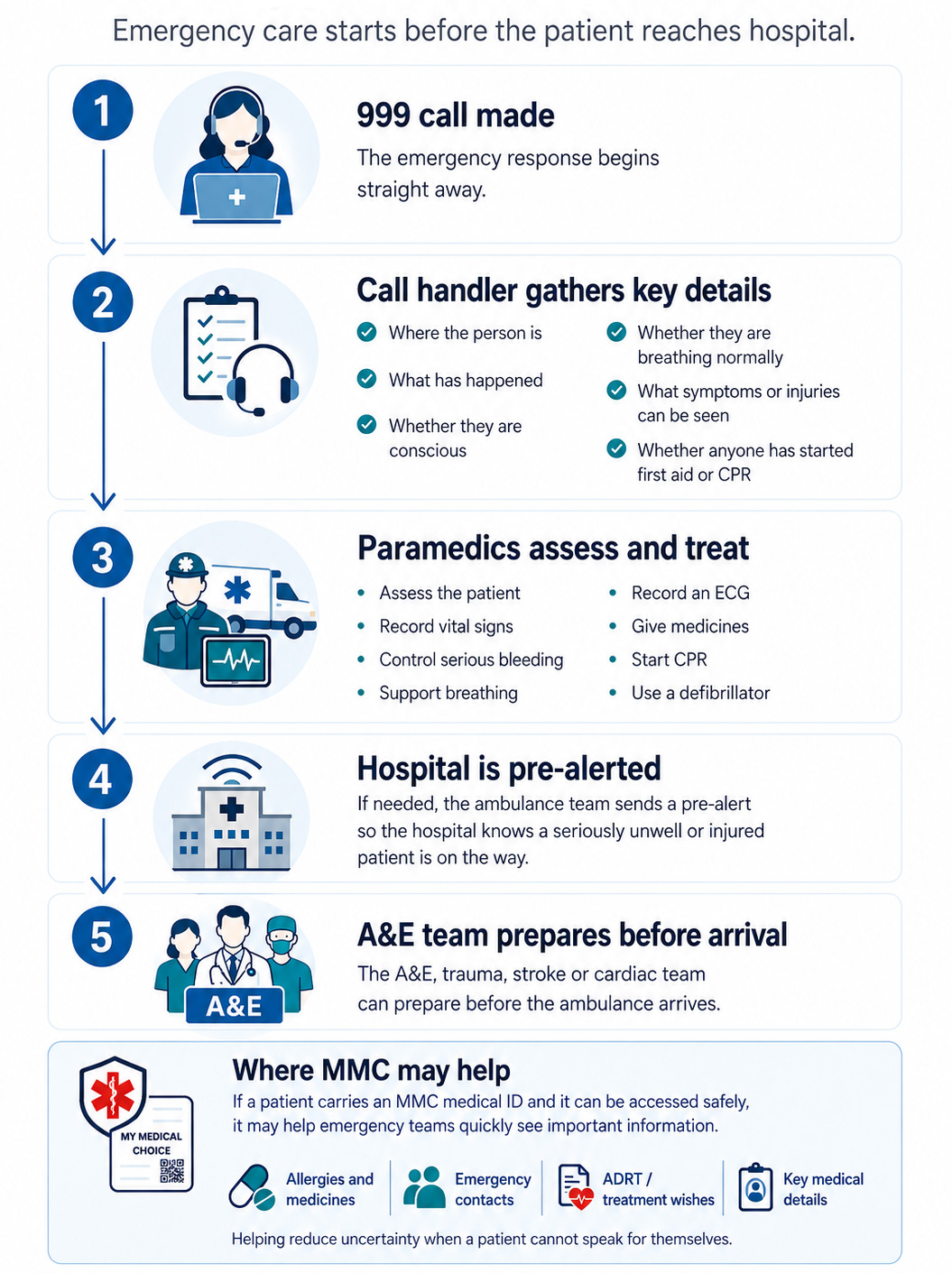
Emergency care starts before the patient reaches hospital.
The call handler will normally ask:
- Where the person is
- What has happened
- Whether they are conscious
- Whether they are breathing normally
- What symptoms or injuries can be seen
- Whether anyone has started first aid or CPR
Paramedics and other pre-hospital clinicians then assess the person, record their vital signs and begin treatment.
Depending on the emergency, they may:
- Control serious bleeding
- Support breathing
- Record an ECG
- Give medicines
- Start CPR
- Use a defibrillator
- Alert a specialist hospital team
This early warning is known as a pre-alert. It allows the A&E, trauma, stroke or cardiac team to prepare before the ambulance arrives.
How paramedics hand over to A&E
A clear handover helps prevent important information from being lost or misunderstood.
For trauma, many emergency teams use a structured system called ATMIST:
- A – Age
- T – Time of the incident
- M – Mechanism of injury
- I – Injuries found or suspected
- S – Signs, including vital signs
- T – Treatment already given
The “M” in ATMIST means mechanism of injury. It does not mean medical history or medication.
Emergency teams may gather other information using questions based on AMPLE:
- A – Allergies
- M – Medications
- P – Past medical history
- L – Last meal
- E – Events leading to the emergency
This information may be difficult to obtain when someone is unconscious, confused, frightened or unable to speak.
More information about structured handovers is available from NHS England.
How My Medical Choice may help
In an emergency, the patient may be unable to explain:
- Who they are
- Which medicines they take
- Whether they have serious allergies
- Whether they take blood-thinning medication
- Whether they have an ADRT
- Who should be contacted
Family members may not be present. The patient may also be taken to a hospital that does not have immediate access to their usual records.
When an MMC medical ID is noticed and the profile can be accessed without delaying care, it may give emergency teams useful information within moments.
This may include:
- Full name and date of birth
- NHS number
- Serious allergies
- Current medicines
- Blood-thinning medication
- Insulin and other important medicines
- Existing medical conditions
- Implanted medical devices
- Recent surgery
- Communication needs
- Emergency contacts
- LPA for Health and Welfare details
- The existence and location of an ADRT
- Specific treatment refusals
Having this information available may reduce uncertainty and save valuable time.
It can help clinicians identify important risks, ask the right questions and give a clearer handover to the receiving hospital.
In some emergencies, saving time and reducing uncertainty may support faster, better-informed decisions and may contribute to a better outcome. No medical information system can guarantee how an individual patient will respond or what the final outcome will be.
MMC supports the clinical picture
MMC does not diagnose the patient or tell clinicians which treatment to provide.
The information in the profile supports, but does not replace:
- Clinical assessment
- NHS medical records
- Hospital tests
- Blood tests
- Brain or body imaging
- Professional judgement
- Local ambulance and hospital procedures
Emergency care must never be delayed while someone searches for a medical ID or tries to access a profile.
An illustrative example: how MMC could help
A serious road accident
Anna is involved in a road accident and suffers several injuries.
She is confused and cannot clearly answer the paramedics’ questions. Nobody travelling with her knows her medical history.
The ambulance team begins assessing her injuries and dealing with the immediate dangers. Her emergency care is not delayed while information is gathered.
During the assessment, a paramedic notices Anna’s MMC medical ID.
When the profile is accessed, it shows that Anna:
- Takes a blood-thinning medicine
- Has a serious medicine allergy
- Has undergone recent surgery
- Has an ADRT
- Has appointed an LPA for Health and Welfare
- Has two emergency contacts
The information does not replace the paramedic’s assessment. However, it alerts the team to details that Anna cannot provide herself.
The blood-thinning medicine may be particularly important where internal bleeding or a head injury is suspected. The allergy may also affect which medicines are considered.
The ambulance team can pass this information to A&E alongside its normal ATMIST handover.
The MMC profile also alerts the team to the existence of Anna’s ADRT. The hospital must still locate and check the signed document to decide whether it is valid and applies to the treatment being considered.
When Anna’s profile is first accessed, the My Medical Choice Automatic ICE Alert notifies her chosen emergency contacts.
In this situation, MMC has not diagnosed Anna or decided her treatment. Its role has been to make important information easier to find at a time when Anna could not provide it herself.
Keeping your MMC profile accurate and up-to-date
A medical profile is only helpful when the information is correct and current.
MMC members should update their profile whenever there is a change to:
- Medicines
- Allergies
- Medical conditions
- Emergency contacts
- Legal documents
- Treatment preferences
Members should also check that their medical ID card or bracelet remains visible and easy to find.
An old medicine list or incorrect contact number could cause confusion instead of saving time.
Why immediate access to medical information matters
During an emergency, clinicians may need to make important decisions before the patient can explain their medical history or treatment choices.
A My Medical Choice profile can bring selected information together in one place, including:
- Serious allergies
- Current medicines
- Blood-thinning medication
- Existing medical conditions
- Implanted medical devices
- Emergency contacts
- LPA for Health and Welfare details
- The existence and location of an ADRT or Advance Decision Notice
- Specific treatment refusals
When the MMC medical ID is noticed and accessed, this information may be available within moments.
That can reduce time spent searching for important details, help clinicians identify risks sooner and support a clearer handover between paramedics and A&E teams.
In a time-critical emergency, saving valuable moments and reducing uncertainty may help clinicians make faster, better-informed decisions and may support a better patient outcome.
Making a legally binding treatment refusal easier to find
A valid and applicable Advance Decision to Refuse Treatment, or ADRT, is legally binding in England and Wales.
Healthcare professionals must follow it where they are satisfied that it:
- Belongs to the patient
- Was made when the person could understand the decision
- Has not been withdrawn
- Clearly refuses the treatment being considered
- Applies to the present circumstances
Where an ADRT refuses life-sustaining treatment, it must be written, signed and witnessed. It must also state clearly that the refusal applies even if the person’s life is at risk.
Once clinicians are satisfied that the ADRT is valid and applies to the situation, the refused treatment must not be given. It cannot be overridden simply because a clinician or another person believes that the treatment would be in the patient’s best interests.
The MMC system does not create the legal authority of the ADRT. That authority comes from the Mental Capacity Act 2005 and from the document being completed correctly.
MMC’s role is to help make the document and its supporting information easier to find when the patient may be unable to speak for themselves.
For MMC members: The system works best when the profile is kept up to date, the medical ID card or bracelet is easy to see, and the uploaded ADRT is the current signed version.
Emergency teams will still carry out normal clinical checks and confirm that the information relates to the correct patient. These checks support safe care; they do not remove the legal force of a valid and applicable ADRT.
Can a recorded blood group be used?
A blood group recorded in a medical profile may provide background information, but it cannot be used by itself to select blood for transfusion.
Hospitals must follow strict patient identification, blood-grouping and compatibility-testing procedures.
Where blood is needed immediately, emergency teams follow established major haemorrhage and emergency transfusion procedures.
Medical choice under the Mental Capacity Act 2005
An adult who can understand, consider and communicate a medical decision can agree to or refuse treatment.
This includes the right to refuse treatment even where doctors believe that the decision could lead to serious harm or death.
An Advance Decision to Refuse Treatment, known as an ADRT, allows someone to refuse a particular treatment in advance.
It is used if that person later becomes unable to understand or communicate the decision.
The law discussed in this article is the Mental Capacity Act 2005, which applies in England and Wales.
When is an ADRT legally effective?
An ADRT must clearly identify:
- Which treatment is being refused
- The circumstances in which the refusal should apply
- That the decision was made freely
- That the person understood the decision when it was made
The person must not have withdrawn the decision or later done something that clearly conflicts with it.
Where an ADRT refuses life-sustaining treatment, it must:
- Be in writing
- Be signed by the person
- Be signed by a witness
- State clearly that the refusal applies even if the person’s life is at risk
Where an ADRT remains valid and applies to the treatment being considered, healthcare professionals must follow it.
See the NHS guide to advance decisions.
Why access to an ADRT matters
A carefully written ADRT may be difficult to follow if nobody knows it exists.
During an emergency, clinicians may need to establish:
- Whether an ADRT exists
- Whether it belongs to the patient
- Whether it remains valid
- Whether it covers the treatment being considered
- Whether it applies to the present circumstances
Making the document easier to find may reduce delay and uncertainty.
MMC allows members to record that they have an ADRT and make the document accessible through their medical profile.
This does not make the ADRT legally valid by itself. Its legal effect comes from the wording, signatures and circumstances in which it was made.
However, digital access may help bring the document to the attention of A&E clinicians when the patient cannot speak for themselves.
ADRTs and an LPA for Health and Welfare
A person may appoint someone under an LPA for Health and Welfare.
The attorney may make certain health and treatment decisions when the person can no longer make the particular decision themselves.
The wording and dates of an ADRT and LPA can affect which one takes priority.
Anyone creating both documents should make sure they do not conflict. Legal advice may be helpful where life-sustaining treatment is involved.
An emergency profile should clearly record:
- That an ADRT exists
- The date it was signed
- Where the signed document can be found
- Whether an LPA for Health and Welfare exists
- The attorney’s contact details
Can someone refuse a blood transfusion?
An adult who understands the decision can refuse a blood transfusion.
This right applies even where refusing blood could result in serious harm or death.
If the person later becomes unable to decide or communicate, a valid and applicable ADRT may continue that refusal.
Because a blood transfusion may be life-sustaining, the ADRT must meet the additional legal requirements described above.
The refusal should make clear:
- Which blood components are refused
- Whether the refusal applies during an emergency
- Whether it applies during surgery
- Whether it applies even if the person’s life is at risk
- Which treatments or procedures remain acceptable
Recording the ADRT in an MMC profile may help alert clinicians to its existence.
The medical team must still check the signed document and decide whether it remains valid and applies to the situation.
An ADRT allows someone to refuse treatment. It does not require clinicians to provide an alternative treatment that they believe is unsafe, unsuitable or unavailable.
What information helps emergency teams most?
The best emergency profile is clear, brief and current.
Useful information may include:
- Serious allergies and the reaction they cause
- Current medicines and doses
- Blood-thinning medicines
- Insulin and other time-critical medicines
- Important medical conditions
- Implanted medical devices
- Recent surgery
- Communication needs
- ADRT details
- LPA details
- Emergency contacts
A longer profile is not always a better profile. Emergency teams need to find the most important details quickly.
What should you do in an emergency?
Someone is unresponsive
Call 999 immediately.
Check their breathing while waiting for the call to be answered.
If they are not breathing normally, start CPR and use an AED as soon as one becomes available.
Follow the call handler’s instructions.
You suspect a stroke
Call 999 after any FAST symptom.
Note when the symptoms started or when the person was last known to be well.
Do not wait to see whether the symptoms disappear.
Someone has suffered serious trauma
Call 999.
Apply firm pressure to serious external bleeding where it is safe to do so.
Do not give the person food or drink. Avoid moving them unless they are in immediate danger.
Follow the call handler’s instructions.
Frequently asked questions
What is the Golden Hour in the NHS?
The Golden Hour is a way of explaining why early assessment and treatment matter during a serious emergency.
It is not a fixed NHS rule stating that every patient must receive treatment within exactly 60 minutes.
Different emergencies have different treatment windows.
Does every emergency patient have one hour?
No.
A person in cardiac arrest needs CPR and defibrillation within minutes. Stroke and major trauma follow different clinical pathways.
The Golden Hour should be understood as a reminder to act quickly rather than a precise medical deadline.
Is an ADRT legally binding for a UK paramedic?
The information here applies to England and Wales.
Paramedics and other healthcare professionals must follow an ADRT when they know it exists and are satisfied that it remains valid and applies to the proposed treatment.
Where there is genuine doubt, they may provide emergency treatment while the position is checked.
How do emergency teams check for medical alerts?
Emergency teams may obtain information from:
- The patient
- Family members or carers
- Medical ID cards or jewellery
- Medicine packaging
- Ambulance and hospital records
- NHS clinical systems
- An ADRT or emergency-care plan
- A digital medical profile
There is no single system that guarantees every medical alert will be found. Immediate care always comes first.
Can I legally refuse a blood transfusion?
Yes.
An adult who understands the decision can refuse a blood transfusion.
In England and Wales, a valid and applicable ADRT may continue that refusal if the person later becomes unable to decide or communicate.
Will A&E automatically follow everything recorded in MMC?
No.
An MMC profile may alert clinicians to important information, but they must still carry out their own checks and use professional judgement.
A digital profile cannot make an invalid ADRT legally binding or require clinicians to give treatment that they believe is unsuitable.
Can the blood group in an MMC profile be used for a transfusion?
Not by itself.
Hospitals must follow strict patient identification, blood-grouping and compatibility-testing procedures.
A recorded blood group may provide useful background information, but it cannot replace hospital testing.
How My Medical Choice supports emergency preparedness


My Medical Choice allows members to keep selected medical information, emergency contacts and healthcare documents together in one secure profile.
The profile can be accessed through an MMC medical ID card or bracelet when the member cannot provide the information themselves.
When your medical profile is first accessed, the Automatic ICE Alert can notify the member’s chosen emergency contacts.
Where the medical ID is noticed, the profile is accessible, and the information has been kept up to date, MMC may:
- Help confirm the patient’s identity
- Highlight serious allergies
- Show important medicines
- Identify existing medical conditions
- Provide emergency contact details
- Alert clinicians to an ADRT or LPA
- Reduce time spent searching for information
- Support a clearer clinical handover
IMPORTANT: Its value lies in making important information easier to find when the patient may be unable to speak for themselves.
In a time-critical emergency, saving even a few valuable moments may help reduce uncertainty and support faster, better-informed decisions.
Related Reviewed Guides
* Medical guidance changes over time. This article is periodically reviewed and updated to help ensure the information remains accurate and reflects current UK guidance where applicable.

Medical and legal disclaimer
This article provides general information for adults in England and Wales. It does not provide individual medical or legal advice.
Call 999 where someone may have a life-threatening illness or serious injury.
Anyone creating an ADRT or refusing life-sustaining treatment should consider discussing their wishes with an appropriately qualified healthcare professional and, where necessary, a solicitor experienced in mental-capacity law.
Editorial references
- NICE NG39: Major trauma – assessment and initial management
- NICE NG128: Stroke and transient ischaemic attack in people aged over 16
- Resuscitation Council UK: Adult Basic Life Support Guidelines
- NHS England: Structured clinical handover